


CELEBRATING ONE OF AMERICA'S FIRST STREET CAR SUBURBS
In 1890, a new kind of neighborhood began to take shape on former farmland at the edge of Washington, D.C. The modern planned community of Chevy Chase, Maryland was designed to take advantage of a revolutionary mode of rapid transit: the streetcar. This electric-powered conveyance made commuting from a home in the country to work in the nation’s capital fast, easy and convenient. Residents of Chevy Chase enjoyed the best of both worlds – and they made the most of each!
Today’s residents and members of the Chevy Chase Historical Society protect and treasure the character of their community while they welcome the best aspects of the future. We welcome you to join us – and to explore our history.
The Chevy Chase Historical Society Archive and Research Center is open to the public by appointment only. For more information, contact us at 301-656-6141 or info@chevychasehistory.org.

Chevy Chase Historical Society invites you to an illustrated talk:
"Celebrating 100 Years of History at Bethesda-Chevy Chase High School"
Sunday, November 1, 2026, 3:00 PM
Bethesda Chevy Chase High School, 4301 East-West Highway, Chevy Chase, MD
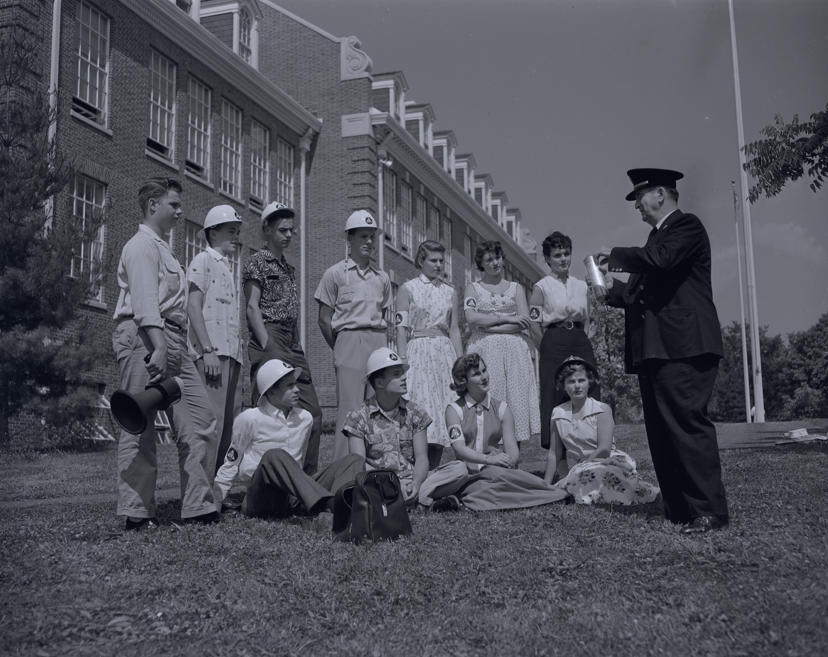
Unpublished photograph of the B-CC nuclear bomb drill taken during a 1954 photo shoot for the Saturday Evening Post article titled “This School is Ready for the H-bomb.” Courtesy of the Oliver Atkin Collection, 0036, Box 54, Folder 118, Image 37, Special Collections Research Center, George Mason University Libraries.
As part of B-CC High School’s Centennial year celebration, please join us at B-CC (4301 East-West Highway) on Sunday, November 1, at 3 pm to view the new Centennial Museum and hear from Lucy Harvey, the museum exhibit developer and mother of three B-CC alumnae. She will discuss milestones from B-CC's first century, describe how the exhibit was developed, and then guide visitors through the gallery.
Founded in 1926 as a segregated, neighborhood school on former farmland, B-CC has transformed into a cosmopolitan, urban high school serving 2,400 students from 55 countries.
Like most American high schools, B-CC has ushered generations of students through the time-honored rituals of dances in the gym, football games, car washes, and bake sales. But unlike other high schools, B-CC has had unique exposure that makes its history extraordinary. The school has a penchant for attracting First Ladies (three to date) and presidential candidates (including then-junior Senator John F. Kennedy) as commencement speakers. It claims a number of firsts, including developing the first school nuclear disaster plan, which became a national model, and participating in one of the first student exchanges with the Soviet Union. B-CC was also on the front lines of voluntary desegregation in 1955, school busing in 1976, and the fight to secure state education funding when Maryland was courting the NFL team that eventually became the Baltimore Ravens.
Our speaker, Lucy Harvey, has developed museum exhibits, websites, as well as online and video content for such clients as the Smithsonian Institution’s National Museum of American History, Mount Clare House Museum, the SEC Historical Society, and The Discovery Channel. She holds a History degree from Dartmouth College, a Master's degree in Journalism from Columbia University, and a certificate in Museum Studies from George Washington University.
This event is sponsored by Chevy Chase Historical Society in collaboration with The Bethesda-Chevy Chase Educational Foundation and PTSA.
The program is free and open to the public.
For more information, please contact CCHS at 301-656-6141 or info@chevychasehistory.org.
Watch our 2026 Spring Lecture “Becoming Americans: 1774"
In this presentation, highlighting Montgomery County's earliest voices, historian Sandra Heiler brings to life the events of June 11, 1774. On this day, ten local citizens gathered in what would later become Rockville, Maryland to adopt the Hungerford Resolves, a daring declaration that aligned their community with the growing colonial resistance movement. In her illustrated lecture, Heiler explores how these agreements marked a profound shift in identity, as colonists began to see themselves not merely as British subjects, but as Americans. She traces the political tensions that shaped the Resolves, highlights their key provisions, and considers their broader impact on the unfolding story of the American Revolution.